Search Competitive Gap Matrix: What Rivals Cover That You Skip
Open the first page of results, list what each page covers, and mark where you are silent. A matrix that separates table stakes from real differentiators, so you do not copy a rival outline.
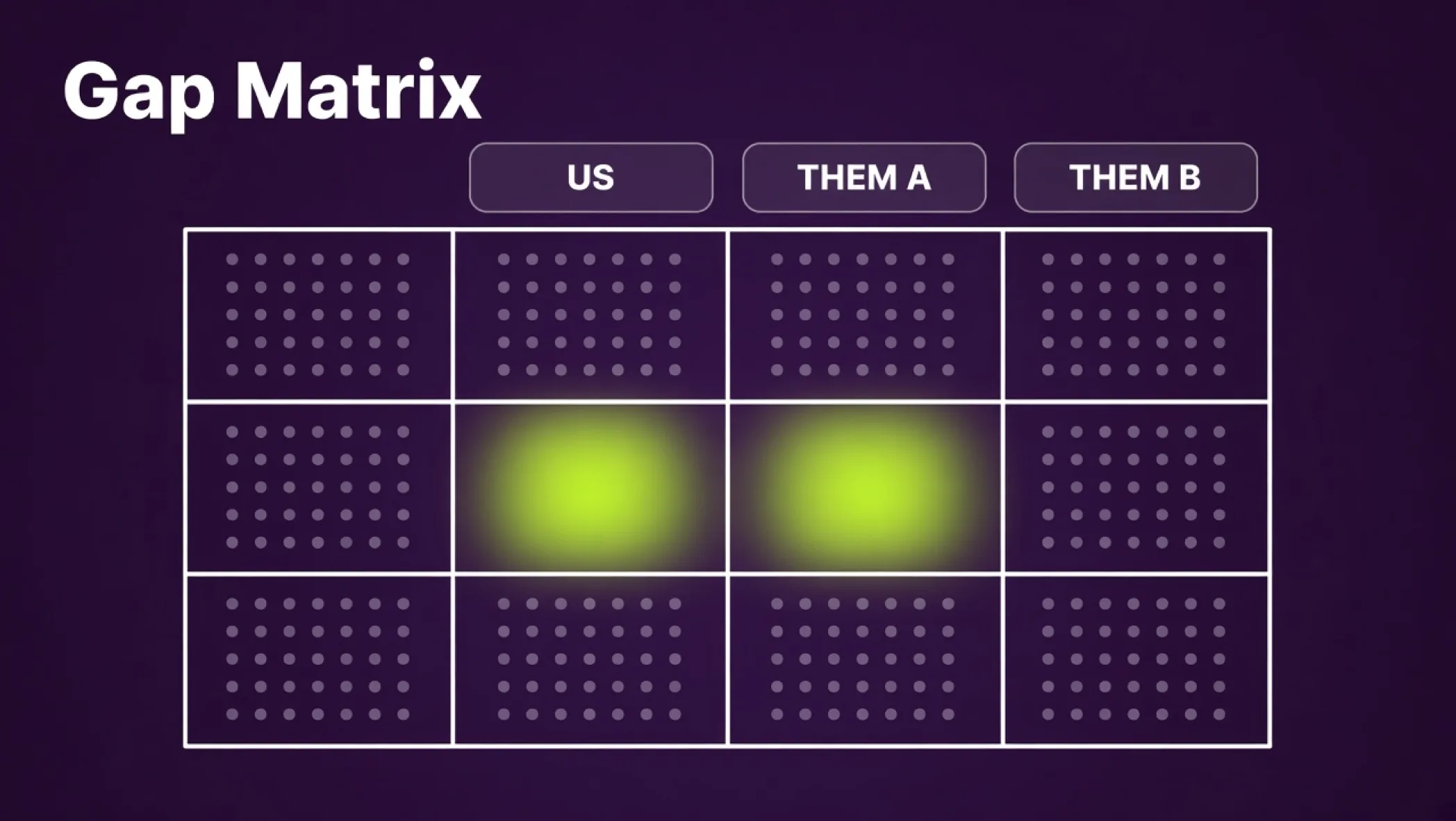
You are about to write a page for a query where five other pages already sit on the first screen. You can guess what they miss, or you can look. The gap matrix is the look: a grid, one row per thing a reader needs, one column per page, and an honest mark in every cell, including your own.
It sits between the brief and the draft. The brief names the query, the URL, and the information gain you plan to add. The matrix tests whether that gain is real. Start with the SEO content brief method if you do not have one. The blank form for this article is the search competitive gap matrix worksheet.
What a gap matrix is for (and the trap inside it)
A gap is a thing a reader needs that a page does not give them. The matrix finds three kinds: topics the rivals cover and you skip, details everybody skips, and claims the rivals get wrong. Only the first kind is “catching up.” The other two are where your page earns its place.
The trap is turning every empty cell into a section. Google’s helpful-content questions include whether you are mainly summarizing what others have to say without adding much value, and whether content draws on other sources without simply copying or rewriting them. Source: Creating helpful, reliable, people-first content (Search Central, checked 1 October 2026). A matrix that ends in “we will cover everything they cover” is a recipe for exactly that.
Build the matrix in five steps
- Pick one query and one intent. If you cannot say what job the searcher is hiring a page to do, go back to the brief. A matrix for a muddled query will be muddled too.
- Search in a private window and write down the first three to five organic pages that match the intent. Skip ads, videos, and pages that answer a different question. Note the date and your location, because results shift.
- Read each page fully, not just the headings. List the rows: every topic, example, template, diagram, number, and decision rule a reader would use. Merge near-duplicates so you end up with 10 to 20 rows, not 60.
- Mark each cell with one of four marks: Covered, Thin, Skipped, or Wrong. Mark your own page, or your own planned outline, in the same grid.
- Sort the rows into four buckets: table stakes, differentiator, skip on purpose, and correction. Then write the decision next to each row.
| Mark | Meaning | Typical decision |
|---|---|---|
| Covered | The page answers it clearly and correctly | Table stakes if most rivals have it. Cover it briefly or link out |
| Thin | Mentioned in a line, no example or method | A candidate differentiator. Give it a real section |
| Skipped | Absent from the page | If every rival skips it, it may be your gain. If one skips it, check why |
| Wrong | Outdated, unsupported, or contradicted by a primary source | A correction. Cite the primary source and say so plainly |
Choose the right rows
Rows are where most matrices go wrong. Too coarse (“content quality”) and nothing is learned. Too fine (every sentence) and the sheet becomes a novel. A good row is something a reader could act on or be annoyed to find missing.
- Topics: the sub-questions the reader has, in their order. “What it costs” and “what can go wrong” are rows. “Introduction” is not.
- Format: table, checklist, screenshot, template, calculator, code. If every ranking page is a wall of text, a clear table is itself a gap.
- Evidence: first-party screenshots, dated tests, named sources. Note who has real proof and who is repeating common knowledge.
- Decision help: do any of them tell the reader when to do X and when not to? Pages that explain but never advise leave room for yours.
- Freshness: dates, versions, and screenshots that no longer match the product. A stale page is a row too, and a correction opportunity, but only if you can prove the current state.
Turn gaps into decisions, not sections
Each flagged row gets exactly one outcome. Google’s AI optimization guide warns that creating separate content for every variation of how people might search, primarily to manipulate rankings or generative AI responses, violates the scaled content abuse policy, and that a high quantity of pages does not make a website higher quality. Source: Optimizing your website for generative AI features on Google Search (Search Central, checked 1 October 2026). So a gap does not equal a new URL. The policy angle is covered in scaled content abuse and AI-assisted pages.
| Bucket | Rule | Where it goes |
|---|---|---|
| Table stakes | Most rivals cover it and readers would be surprised to miss it | A short section on the target page. Link to a deeper page if you have one |
| Differentiator | Rivals are thin or silent and you can prove something | The center of the page. Needs a first-party block |
| Correction | A rival claim conflicts with a primary source | A cited paragraph. Name the source, not the competitor |
| Skip on purpose | Off-intent, outside your expertise, or a different URL’s job | Nowhere. Write the reason in the sheet so nobody reopens the debate |
| New URL candidate | A gap with its own intent and its own next step | Only after the sibling test: no existing page owns it |
Filled hypothetical: a four-person studio, one query
Hypothetical example, labeled as such, not a real SERP read. A studio plans a page for “website migration checklist.” Three ranking pages are compared across five rows here. A real sheet would run 10 to 20.
| Row | Page A | Page B | Page C | Our plan | Bucket |
|---|---|---|---|---|---|
| Redirect map explained | Covered | Thin | Covered | Covered, short | Table stakes |
| Rollback plan | Skipped | Skipped | Thin | Full section with a worked example | Differentiator |
| DNS timing | Wrong | Covered | Skipped | Cite the vendor doc | Correction |
| Stakeholder sign-off | Skipped | Skipped | Skipped | Owner and approver table | Differentiator |
| Tool recommendations | Covered | Covered | Covered | Skip | Skip on purpose |
Read the result. Of five rows, the studio covers one briefly, cites a vendor doc for one correction, builds two differentiators, and skips one on purpose. No ranking page offers a rollback plan or a sign-off table. That is the information gain. The page does not need to be longer than a rival’s. It needs to be more useful at one specific moment, which is when the cutover goes wrong.
Check yourself against Search Console
If the page already exists, the matrix gets better with your own data. Open Google Search Console (GSC), filter the Performance report to the page, and look at the queries it already gets impressions for. Rows that map to queries with impressions and weak clicks are worth a stronger section. Rows with no impressions and no rival coverage may be your idea, not the reader’s.
Treat impressions and clicks as diagnostics, not proof the page works. What the numbers can and cannot tell you is in how to measure SEO beyond rankings.
Failure modes
- Outline cloning: you merge three rival outlines and write the union. Fix: only rows you can add evidence to become sections.
- Wrong competitors: you compare against a brand that ranks for a different intent. Fix: use only pages on the same first screen for your exact query.
- Word-count envy: you aim to be longer than rival A. Google’s guidance explicitly says it has no preferred word count. Aim to be useful at a moment, not long.
- Gap equals URL: every empty cell becomes a new post. Fix: run the sibling test, then add the section to the page that owns the intent.
- No decision column: the matrix is admired and then ignored. Fix: no row leaves the sheet without a bucket.
Ship checks
- Date, query, and search location are written at the top of the sheet.
- Every differentiator row names the first-party block that backs it. If it has none, demote it to table stakes or skip it.
- Every correction row has a primary-source link.
- Skipped rows have a one-line reason.
- The brief is updated with the final list before drafting starts.
Print the worksheet and fill it for the next page on your list. For the argument about why the added material matters, read the information gain framework. If you want a team to run this across a whole site and tie it to pages that sell, see how we build websites.
Frequently asked questions
What is a content gap analysis?
A content gap analysis compares what the pages currently ranking for a query cover against what your page covers, then lists the topics, formats, and details you leave out. Used well, it finds missing sections on pages you already have. Used badly, it produces a copied outline. The matrix below keeps you on the first use.
How many competitors should I put in the matrix?
Three to five. Take the pages that actually occupy the first page of the search engine results page (SERP) for your exact query, not the biggest brands in your category. More columns make the matrix unreadable and tempt you to chase every topic anyone mentions.
Should I cover everything my competitors cover?
Cover the table stakes, meaning topics a reader would be surprised to find missing. Skip the rest on purpose and write down why. Google says a high quantity of pages does not make a site higher quality. The same logic applies inside one page: more sections is not the same as more value.
Is copying a competitor’s outline a problem?
Google’s helpful-content questions ask whether content that draws on other sources avoids simply copying or rewriting them and provides substantial additional value and originality. An outline lifted from three pages and filled in with your own words fails that test. Use rival coverage as a map of what readers expect, then add what you can prove.
Do I need a paid tool to build this?
No. An incognito search, a spreadsheet, and Google Search Console (GSC) are enough for one query. Paid tools can speed up pulling lists of ranking pages across many queries. They cannot decide which gaps are worth filling. That is the editor’s job.
How often should I redo the matrix?
When you plan or refresh a page, and again if impressions in GSC for that query drop and the results page looks different. Do not schedule it as a monthly ritual for every URL. A matrix without a decision attached is just a spreadsheet.