How to Measure SEO Beyond Rankings: From Search Console to Leads
Average position is a diagnostic, not a scoreboard. How to read impressions and clicks in Google Search Console, compare them to Analytics sessions without forcing a match, and count qualified inquiries instead of pretending a rank caused revenue.
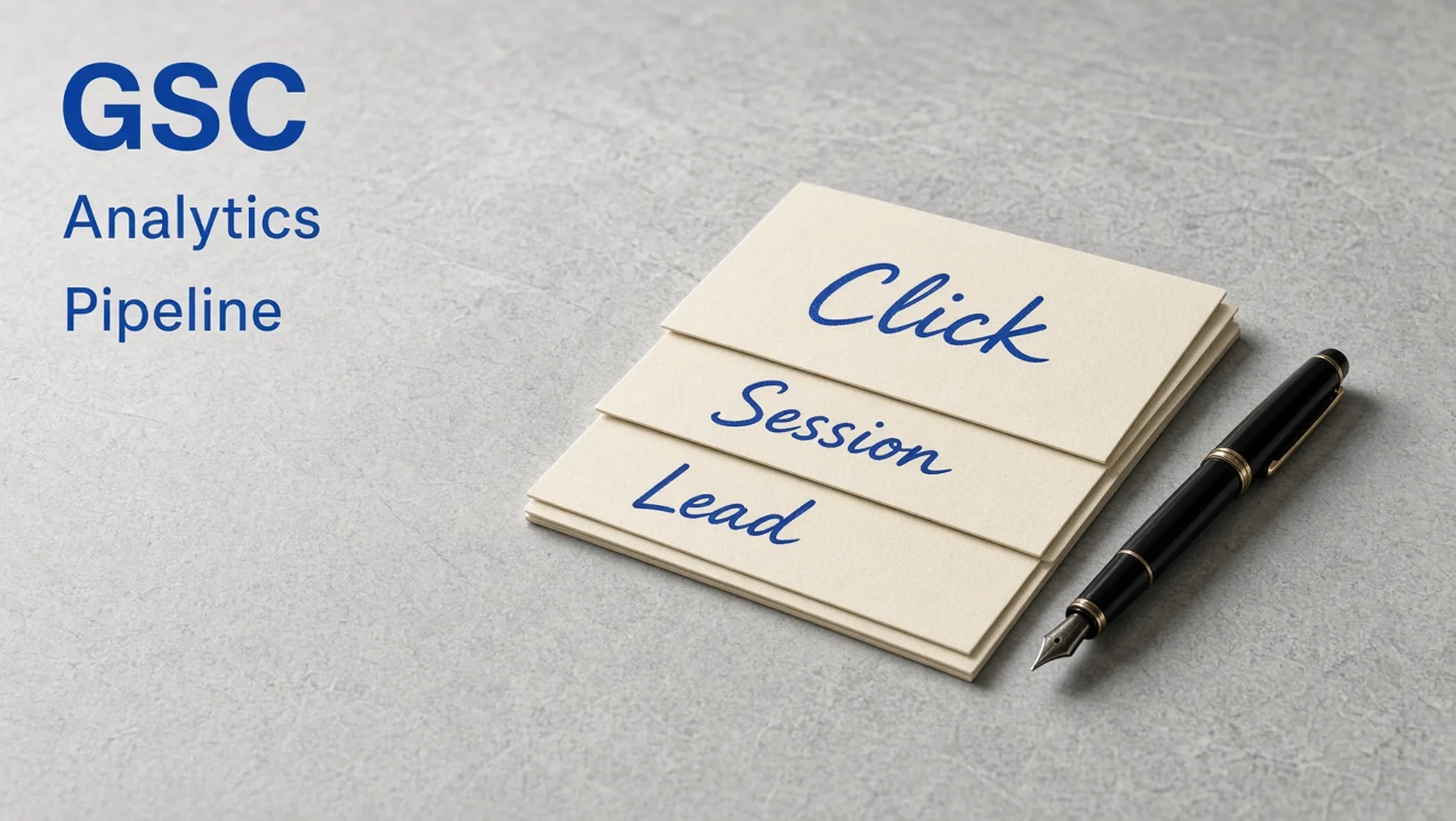
Rank tracking feels like work. It is usually a mood. A page can sit at position four and still send nobody who can buy. Another can sit on page two and send three qualified conversations because the query was ready. If the only number you screenshot is average position, you are managing a leaderboard, not a pipeline.
This page is the measurement spoke. The map is still the complete SEO guide. If the first HTML is empty, graphs lie, so inspect with Search Console URL Inspection. The five commercial numbers live on the growth scorecard.
What each tool is actually allowed to claim
Sourced from Google. Google Search Console (GSC) measures Search appearance and clicks (impressions, clicks, click-through rate (CTR), average position). Analytics measures what happens after someone arrives. They overlap. They do not reconcile to the cent. See Using Search Console and Google Analytics data for SEO (Search Central, checked 16 September 2026).
| Signal | Where | Means | Does not mean |
|---|---|---|---|
| Impression | Search Console | Your result was shown in Search (or Discover / News, depending on the report) | A person read you, or will click |
| Click | Search Console | Someone clicked a Search result that points at your site | A session, a lead, or a sale |
| CTR | Search Console | Clicks divided by impressions for that slice | The title is “optimized.” It might just be the only result they recognized. |
| Average position | Search Console | Average of the topmost result from your site in that grouping | A guaranteed rank you can put in a proposal |
| Session | Google Analytics 4 (GA4) | A period of on-site interaction | The same event as a GSC click |
| Key event | GA4 | An event you marked as important (for leads, often generate_lead) | A qualified buyer. That is still a human mark. |
The pipe, drawn once
flowchart LR
        I["Impression"] --> C["Click"]
        C --> S["Session"]
        S --> F["Form submit"]
        F --> Q["Qualified conversation"]
        Q --> P["Proposal"]
        I -.-> X["GSC only"]
        S -.-> Y["GA4"]
        Q -.-> Z["Intake sheet"]
The dotted labels are the store. If you try to keep all six numbers in Search Console, you will invent a story. If you try to keep them all in Analytics, you will lose the query. Keep each number in the tool that owns it, then join on landing page and week, not on fantasy IDs.
A Monday pass that does not turn into rank stalking
Google’s Search Console start guide says you do not need the tool daily. Monthly is enough unless you shipped a change. When you do open it, do this, in order. Source: Get started with Search Console.
- Performance report, last 28 days versus the prior 28. Look at clicks first, then impressions. Position last.
- Pages tab. Note the three URLs with the biggest click change. Those are the only pages you debug this week.
- Queries tab for those URLs, not for the whole domain. You are checking intent, not harvesting a keyword list.
- In GA4, Traffic acquisition: Organic Search, source Google, same dates. Compare the click trend to the session trend. If they diverge hard, check consent, filters, and whether the landing URL in GSC is the URL Analytics sees (trailing slash, www, parameters).
- Landing page report, Google organic only. Did those three URLs reach a key event? If clicks rose and key events did not, the page is visible and useless for the offer. That is a site or brief problem, not a “we need more keywords” problem.
Form submit is not a lead
GA4 can collect form_submit automatically when Enhanced Measurement is on. That event means a form was submitted. Google’s recommended event for a business inquiry is generate_lead. Mark that as a key event if it is the on-site goal. Still do not treat it as pipeline. Spam, students, and “just researching” will fire it too. Qualify on the intake sheet.
How you fire generate_lead, and how consent mode changes what you are allowed to store, belongs in the website measurement plan. This page only needs the rule: Search success is a click that later became a qualified conversation, not a blue link that moved up a slot.
Filled hypothetical: a studio that was celebrating position
Hypothetical, labeled as such. A studio’s money page sits at average position 4.2. Clicks are flat. The founder wants more posts. The Monday pass shows the page earns impressions on “cheap website Nairobi” and almost none on the actual offer query. GA4 shows organic sessions, almost no generate_lead. The intake sheet has two qualified conversations, both from referrals.
The honest read: visibility is on the wrong intent. More articles will not fix that. A brief, a title, and a who-line will. Rank tracking would have said “we are winning.” The pipe said you are not.
What this does not prove
A click is not a session. A session is not a lead. A lead is not revenue. A 28-day uptick after a publish is not proof the article caused the inquiry. Say assisted when you cannot isolate the variable. If you need a number for a sales deck, use the intake sheet and a date range, not a rank chart.
If the site cannot close the query it ranks for, fix the page as a website, not as a keyword. Start a conversation with the three URLs from last month’s click report, not with a keyword export.
Frequently asked questions
Does Google Search Console show conversions?
No. Google Search Console (GSC) reports how you appear and get clicked in Search: impressions, clicks, click-through rate (CTR), average position, queries, and pages. On-site actions live in analytics or your customer relationship management (CRM). Google’s own Search Central guidance is to compare GSC clicks with Analytics sessions for pattern, not to expect the numbers to match.
Why do Search Console clicks and Analytics sessions disagree?
They count different events. A click in GSC is a click on a Search result that points at your site. A session in Google Analytics 4 (GA4) is a period of on-site interaction. Different systems, cookies, consent, bots, and landing-page filters. Search Central says to use those two as the most comparable pair and to look at the pattern, not a one-to-one join.
Is average position a ranking I can promise a client?
No. Average position is the average of the topmost result from your site for the rows in that report. It is not “you rank #3 for this keyword everywhere.” It moves with personalization, device, and which queries you include. Treat it as a diagnostic, not a contract.
What should a service business count instead of rankings?
Qualified conversations that came with a search landing page or a “Google / organic” source on the intake row. Rankings without conversations are a hobby. See the growth scorecard for how to count those conversations by hand until the CRM is honest.
Can I attribute a sale to one query in Search Console?
Not cleanly. GSC does not attach a query to a later purchase. You can see which landing pages earned clicks, then in Analytics see whether organic Google sessions on those pages reached a key event. That is assisted, not proven causation.
How often should I open Search Console?
Google’s get-started guide says you do not need it every day. Check around once a month, or when you ship a content or URL change. Email alerts cover new issues. Daily rank stalking is not a measurement plan.