Feature-to-Value Messaging Map: Turn Specs Into Customer Language
A feature list is how you describe the product. A messaging map is how a buyer describes the job. Five columns, one row per feature, and a rule for what gets cut.
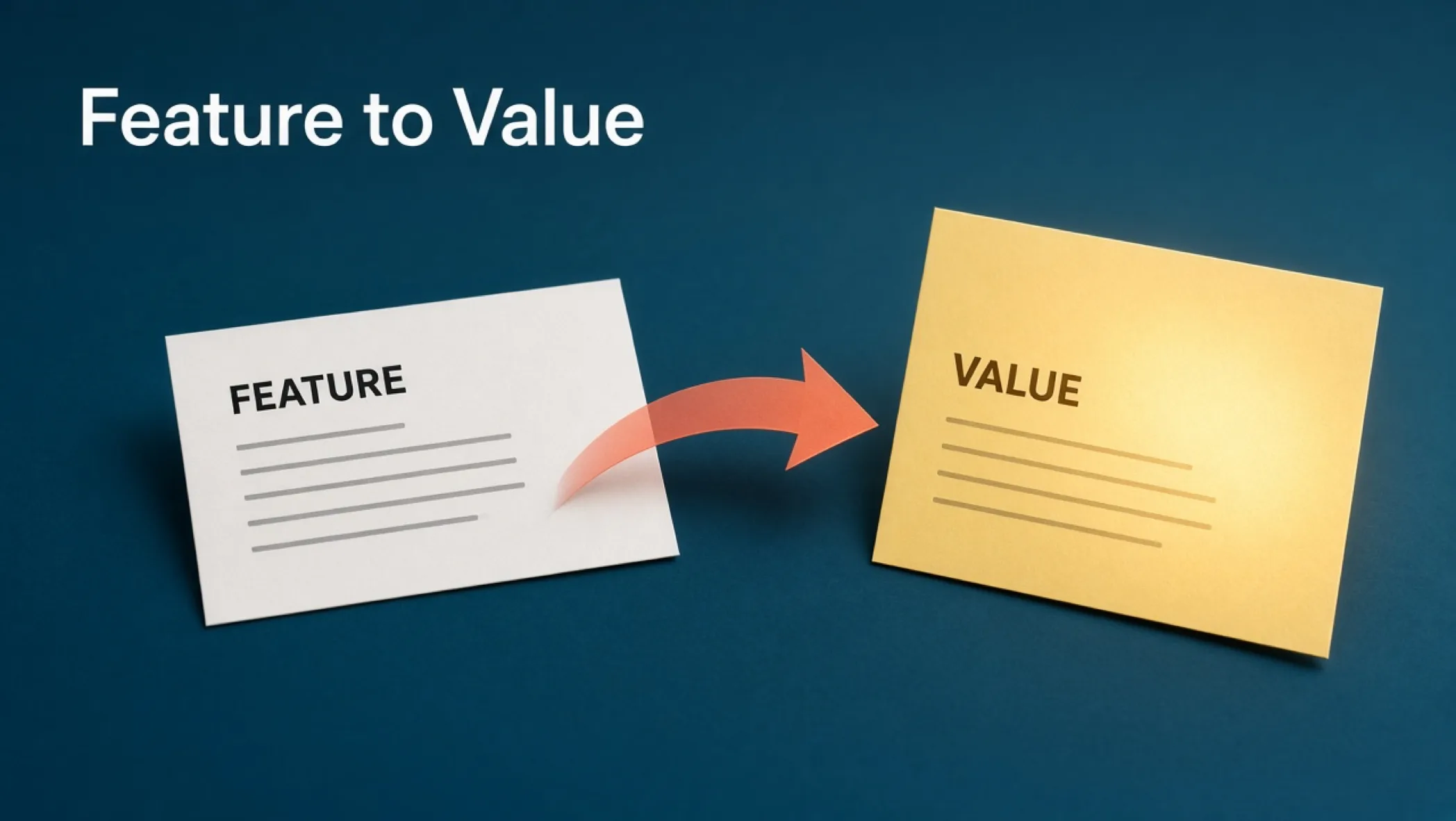
You have a product page that lists what the thing does. Buyers skim it, nod, and leave without knowing whether it fixes their Tuesday. The fix is not a better adjective. It is a table that forces every feature to point at a job a buyer already has.
Print the feature-to-value messaging map and fill it next to your spec sheet. If you have not picked who this is for yet, start with the brand positioning framework. Voice rules that sit on top of the map live in architecting brand voice and messaging.
Why spec language fails on a homepage
A feature is what you built. A job is what the buyer is trying to get done. The buyer never typed your feature name into a search bar or said it on a call. They said “I keep losing track of who replied” and you answered with “unified inbox.” Both are true. Only one gets a second read.
The usual failure is not lying. It is translating too early into your own vocabulary. Engineers name things for how they work. Founders name things for how they feel. Buyers name things for what hurts. Your messaging has to land in the third vocabulary.
The five columns
| Column | What goes in it | Fails when |
|---|---|---|
| Feature | The thing as your team names it, in a few words | It is a benefit in disguise (“peace of mind”) |
| Job it helps | The outcome a buyer already wants, in a verb phrase | It restates the feature (“use the dashboard”) |
| Proof you may claim | A fact you can show: screenshot, process, public page, permissioned client fact | It is a number you cannot source |
| Words customers use | The exact phrase from a call, ticket, review, or email | It is your internal term or a polished paraphrase |
| Words to avoid | Jargon, vague superlatives, anything you cannot back up | The cell is empty, so every writer invents their own |
flowchart LR
        F["Feature"] --> J["Job it helps"]
        J --> P["Proof you may claim"]
        P --> W["Customer words"]
        W --> H["Headline or cut"]
Step 1: List features without defending them
Open the product, the pricing page, the proposal template, and the onboarding email. Write every feature on its own row. Include the boring ones. Include the ones you are proud of. Do not rank yet. This pass takes thirty minutes and tends to surface three things nobody mentioned in the kickoff.
For a service business, each step in your process is a feature. “Discovery workshop” is a feature. “Everyone on your team agrees what the site is for before we draw anything” is the job it helps.
Step 2: Write the job, not the benefit
The job column is a verb phrase in the buyer’s frame. “Stop chasing approvals across three chat apps.” “Show a new hire where the files live on day one.” “Look as considered as the fees we charge.” If the cell starts with “Improve,” “Enhance,” or “Optimize,” you have written a mood. Rewrite it until a stranger could picture the scene.
- Trigger: what happened last week that made the job urgent? A missed deadline, a lost deal, a new hire.
- Frame: what are they doing today instead? A spreadsheet, a freelancer, nothing. That is your real alternative.
- Test: read the cell aloud on a call. If the buyer says “yes, exactly,” keep it. If they ask “what do you mean,” it is still a feature.
Step 3: Fill proof honestly
The proof column is where most maps go to die, usually because someone fills it with “industry-leading.” Use three tiers. First-party: a screenshot of your own tool, a process document, a public page you control. Permissioned: a named client fact they have agreed to share, with scope. Hypothetical: a constructed example, labeled as one. If none of those exist, write “none yet.” That row can still be on the site as a plain statement of what you do. It cannot carry a claim.
The tiers behind “what may I say” get their own treatment in the Claims, Proof, Risk ladder. Use it when a row is tempting you to round up.
Step 4: Borrow the customer’s words
Paste the phrase, quotes and all, with the source in brackets. “We were living in email threads” (sales call, week 3). “I just want to know it will not break” (support ticket). These are your headline raw material. You are not allowed to polish them until the end, and the polish is subtraction, not decoration.
No customer words yet? Mark the cell “guess” and run five short conversations. Ask what they did the last time this problem showed up, not whether they would like your feature. People answer the first question well and the second one politely.
Step 5: Decide headline, line, or cut
| If the row has | Then it becomes | Where it lives |
|---|---|---|
| Job tied to the primary buyer, proof you can show, customer words | Headline candidate | Hero, proposal cover, first line of the pitch |
| Job tied to the primary buyer, no proof yet | Plain statement | Body copy, no superlatives, no numbers |
| Job tied to a secondary buyer | Supporting line | Below the fold or a dedicated page |
| No job anyone mentioned | Cut or demote | Spec page or documentation |
| Only your internal term, no customer words | Rename before shipping | Nowhere until renamed |
Keep three to five headline candidates. The rest are supporting evidence, not equals. A homepage where every feature gets a card of the same size says “we could not decide.” That is a brand message too, just not the one you wanted.
Hypothetical, labeled
Hypothetical. A small studio sells a monthly website care plan. Feature on the sheet: “Uptime monitoring and monthly updates.” Job it helps: stop worrying that the site quietly broke after the last plugin change. Proof you may claim: the studio’s own monitoring dashboard screenshot and a written update checklist. Words customers use: “I do not want to find out from a customer that the form is down.” Words to avoid: “peace of mind,” “industry-leading uptime.” Result: the headline is the customer’s sentence, the proof is the screenshot, and the adjectives are gone.
What this example does not prove: that care plans are the right offer for every studio, or that the phrase will convert. It shows the five cells can be filled without a made-up percentage.
Failure modes that look like progress
- Benefit soup: every row says “save time” or “grow faster.” Add the trigger and the scene or delete the row.
- Persona drift: one row speaks to the buyer, the next to the user, the next to whoever signs the invoice. Split the map by role if you must, but keep one primary.
- Proof laundering: a competitor’s case study quietly becomes your “trusted by” line. Cut it.
- Word cleanup too early: someone rewrites the customer quote into brand voice before the map is done. Lock the raw phrase first.
Run it in a week
- Day 1: list every feature from product, pricing, proposals, and onboarding.
- Day 2: write the job and trigger for each row. Delete rows with no job.
- Day 3: collect customer words from calls, tickets, and reviews. Mark guesses.
- Day 4: fill proof and the avoid column. Empty proof stays empty.
- Day 5: apply the decision table. Pick three to five headline rows. Hand the sheet to whoever writes the page.
The finished sheet is also a good input for a brand brief. If you want help turning it into a homepage and proposal that say the same thing, that is branding and website work we do together. Contact.
Frequently asked questions
What is a feature-to-value messaging map?
A table with one row per feature. Each row names the customer job the feature helps, the proof you are allowed to claim, the words customers actually use, and the words you will not print. It is the bridge between a spec sheet and a homepage.
How is this different from positioning?
Positioning picks who you are for and what you are instead of. The map works one level down. It takes the features you already have and decides which ones get a headline, which get a line, and which get cut. Do positioning first, then the map.
How many features should be on the map?
List everything on the first pass, then keep the three to five that map to the primary job. The rest can live on a spec page or in documentation. A homepage with fourteen equal features has no hero.
Where do I get the words customers use?
From sales call notes, support tickets, reviews, onboarding forms, and the first email a new lead sends. Copy the phrase, not your cleaned-up version of it. If you have none of those yet, mark the cell as a guess and test it in five conversations.
Can I use the same map for a service business?
Yes. Replace “feature” with “thing we do” or “thing in the package.” A step in your process is a feature. The customer job it helps is the outcome they care about, not the step itself.