How to Write a Brand Brief That Designers Can Actually Use
Who, job, offer, proof, constraints, channels, success, and one approver. A brief is a decision document. A moodboard is not.
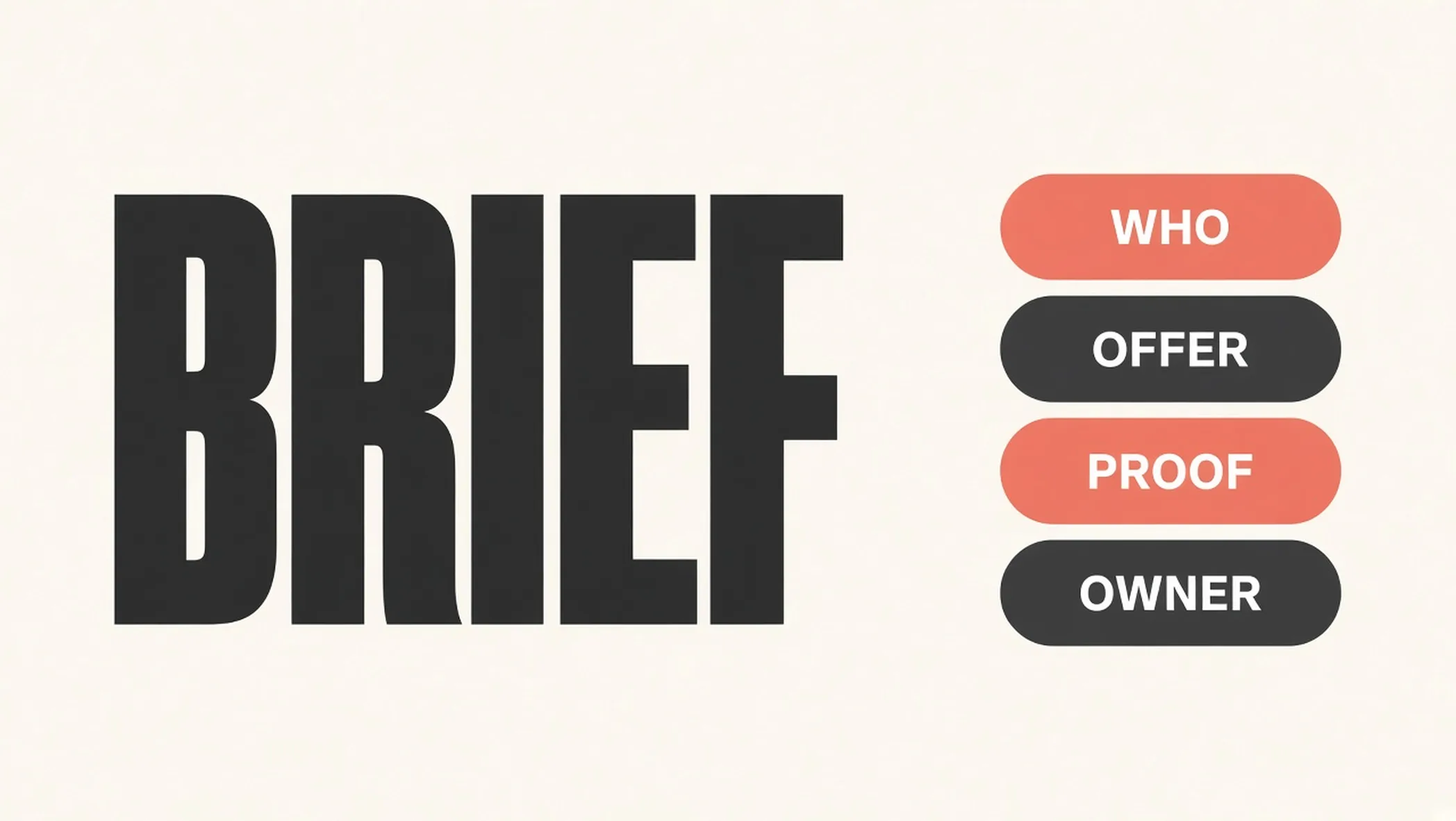
A designer with a moodboard and no brief will invent your company. A brand brief is who, job, offer, proof, constraints, channels, success, and one approver. Visuals come after those cells are filled.
Print the brand brief template. Positioning belongs in the brand positioning framework. The meeting that uses this paper is how we run a branding kickoff. If you do not know whether to rebrand, that is rebrand or refresh. Drift across touchpoints is the brand audit.
What a usable brief holds
| Cell | Good | Useless |
|---|---|---|
| Who | One primary buyer in a sentence | Five personas and “also Gen Z” |
| Job | The job they hire you to do, in their words | “Innovative solutions” |
| Offer | What they buy, one sentence | A service menu of twelve |
| Proof | Named, permissioned, or first-party | “Trusted by leading brands” |
| Approver | One name | The board, in spirit |
flowchart TD
        W["Who"] --> J["Job"]
        J --> O["Offer"]
        O --> P["Proof"]
        P --> A["Approver"]
Who and not-for
One primary. Not-for is a gift. It stops the intern from stretching the mark onto a student offer you do not want. If you cannot name who it is not for, you do not have positioning. You have a crowd. A designer who hears “everyone who needs quality” will draw a mark that means nothing in a feed.
Write the job in their words. “Look as considered as the fees we charge” is a job. “Elevate the brand” is a mood. The offer is what they buy, not the adjective. Mechanism is how it works in one line. If you cannot say the mechanism, the homepage will fake one.
Proof and claims you will not make
Write what you may show. A screenshot you own. A named client with permission. A labeled hypothetical. The cell “we boost conversions” with no baseline is how a homepage becomes a liability. Put the forbidden claims on the brief so a freelancer does not invent a percentage. Empty proof is honest. Fake proof ships.
- Must keep / must kill: name, legal line, a color you are stuck with, a site that cannot move this quarter.
- Channels in order: site, proposal, signage, social, packaging. If the brief only talks logo, the proposals will look like a different firm.
- Success in 90 days: usable templates, one voice on the homepage, sales can paste a who-line. Not “more awareness.”
- One approver: commenters listed. Veto is not a group sport. The kickoff agenda is 90 minutes. The brief is why those minutes do not invent the company.
What a designer does with this paper
They should be able to refuse a direction that contradicts the who-line. They should know which channel ships first. They should know which claims are illegal on this job. If they still ask “what is the vibe,” the cells are empty. A moodboard can sit next to a filled brief. A moodboard cannot replace it.
The website has its own brief (website brief template). Do not smash brand and site into one document unless one person owns both jobs. A brand brief that lists 18 pages is a website brief in costume.
Fill it the week before the room
- Days 1–2: Who, not-for, job, offer. If founders disagree, that is the work. Do not book design yet.
- Days 3–4: Proof you may show and claims you will not. Empty is allowed. Invented is not.
- Day 5: Must keep, must kill, channel order, 90-day success, one approver name.
- Day 6: Send the page to the designer. If they still need a vibe dump, the cells are mush. Rewrite, do not add a Pinterest board as a patch.
A kickoff with this paper takes 90 minutes and ships decisions. A kickoff without it becomes a tour of logos other people made. That is entertainment. It is not a brief.
Hypothetical, labeled
Hypothetical. A two-founder studio sells brand systems to regional professional firms. Who: managing partners who are tired of looking cheaper than their fees. Job: look as considered as the work. Offer: identity system plus website. Proof: their own site and one permissioned case. Approver: founder A. Founder B comments. Must keep: the name. Must kill: three greens. Success: homepage who-line matches the proposal cover in 90 days. That brief can go to a designer. A folder of “competitors we like” cannot.
What that example does not prove: that every studio should sell systems this way. It proves the cells can be filled without a case-study percentage.
Fill the template before you book the room. Branding work that starts from a filled brief is a branding conversation. Contact.
Frequently asked questions
What is a brand brief in this article?
A one-page decision document a designer can work from: who it is for, the job, the offer, proof you may show, constraints, channels, success, and a single named approver. It is not a Pinterest board with a logo request at the bottom.
How is this different from a kickoff agenda?
The kickoff is a meeting. The brief is the paper you walk in with. If the brief is empty, the kickoff invents the company under time pressure. Use both. Do not merge them into one URL.
Can three founders all be approvers?
They can comment. One name ships. A committee veto is how you get a beige mark that offends nobody and helps nobody.
What if we do not have proof yet?
Write first-party or hypothetical, labeled. Do not invent a client result to fill the cell. Empty proof is honest. Fake proof becomes the homepage.