Sales Battle Cards That Get Opened (Not Shelfware)
A battle card is one page about one alternative a buyer might pick instead of you. Write when they pick it, when you tell them to, what you can prove, and three questions. If it is not open on the call, cut it.
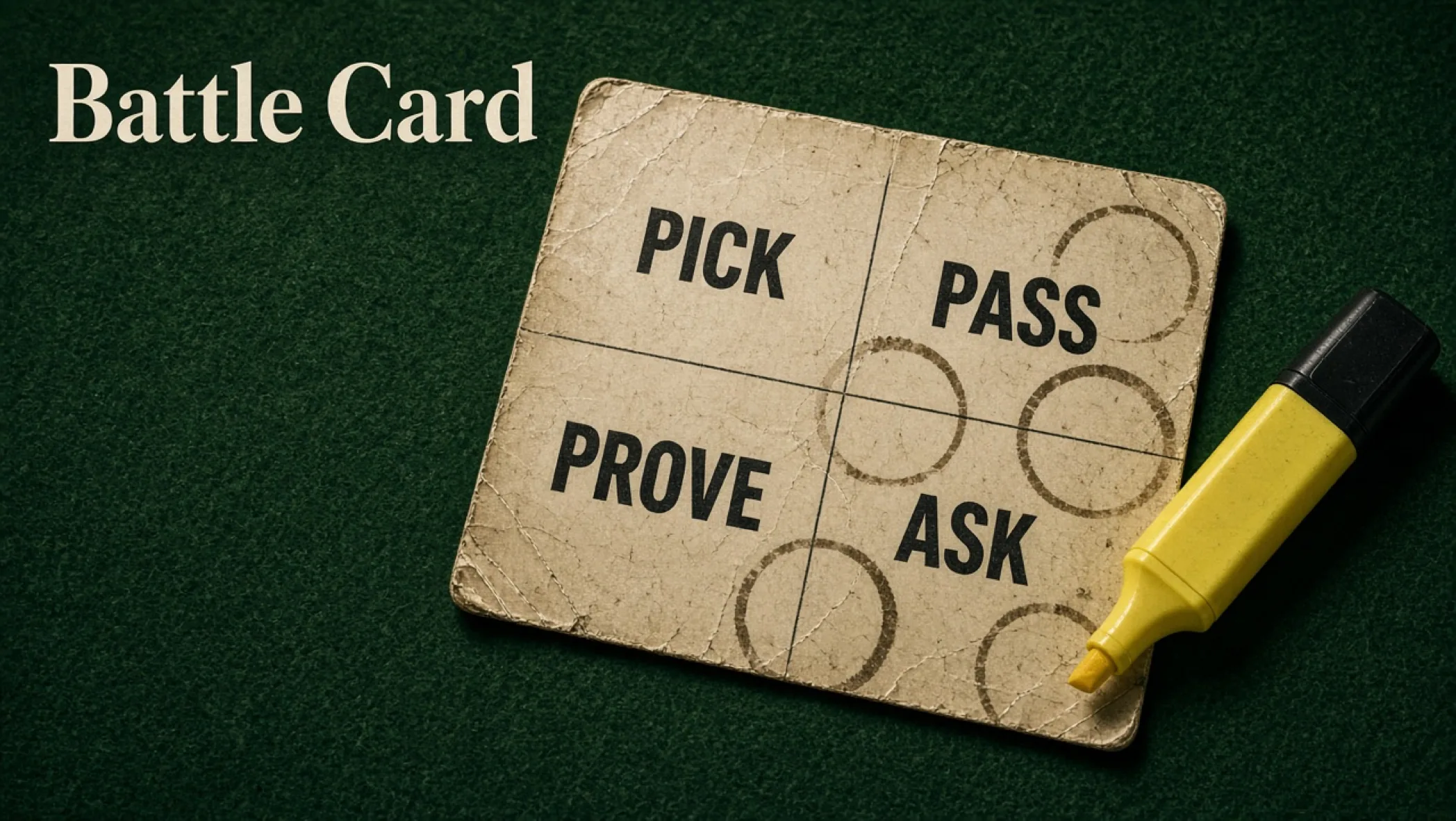
The call is in four minutes. The buyer mentioned another studio in their email. You half remember what you wrote about them last quarter, in a document you cannot find. So you improvise. Sometimes it goes fine. Sometimes you say something about a competitor you cannot back up, and the buyer notices.
A battle card fixes that if it is small enough to open. One page. One alternative. Written for you, in the moment, with nothing on it you cannot defend. Most cards fail because they are written like a binder and filed like a binder. This one is built to be opened, then cut when it is not.
The card assumes the conversation already passed fit. If it did not, start at from qualified conversation to proposal. The blank page is the sales battle card template.
Why battle cards turn into shelfware
Product marketing teams in big companies write battle cards for sales reps who never met the author. A studio with one offer has the opposite problem. You are the author, the rep, and the person who has to remember. So the usual failure is not that nobody reads it. It is that it was written for a version of the call that never happens.
| Shelfware card | Card that gets opened |
|---|---|
| Feature comparison grid | When a buyer picks the alternative, in plain words |
| Lists what is wrong with them | Lists when to tell the buyer to take them |
| Claims you hope are true | Proof you can open in ten seconds |
| Two pages, then four | One page, with a cut rule |
| Written once, never dated | Review date and owner at the top |
| Answers for every possible objection | Three questions, then the objection library for the rest |
The honest column on the right is uncomfortable. It asks you to write the case for the other side. That is the point. A buyer comparing you to something already has a reason to consider it. If your card pretends they have none, your call will sound scripted.
The Pick, Pass, Prove card
This is our method for one-offer service businesses. It is a Framework, not a standard, and it is deliberately short. Five boxes, one page.
flowchart LR
  A["Alternative"] --> K["Pick"]
  K --> S["Pass"]
  S --> R["Prove"]
  R --> Q["Ask"]
  Q --> D["Do not say"]
If the card needs a second page, you have two alternatives on one card. Split it.
- Pick: when a smart buyer chooses the alternative. Write it in their favor. A freelancer is a great pick when the job is small and the owner wants one person to call. Doing nothing is a fair pick when the cost of waiting is low.
- Pass: when you tell the buyer to take it. This is the honest no-fit line. It also saves you from a proposal you should not write. Include the polite exit sentence you will actually use.
- Prove: what you can show today. A page you can open. A scope document. A permissioned client example. Next to each, one line on what it does not prove.
- Ask: three questions, in order. First about their job. Second about what they use now and what it costs them in their words. Third about who decides and by when.
- Do not say: claims about the alternative you cannot source, numbers you cannot show, and phrases that sound like every other pitch the buyer has heard.
What goes on it, and what stays off
Your sources are limited on purpose. A battle card is only as good as what you can defend when the buyer says, “Where did you hear that?”
| Allowed source | Example use | Not allowed |
|---|---|---|
| The buyer’s own words in a note | They said the freelancer is cheaper and available now | You assume their budget is the reason |
| The alternative’s public pages, dated | Their services page lists three packages as of the date you looked | What you guess their margins or capacity are |
| Your own delivery | Your first deliverable and how long it takes you | Industry averages you cannot cite |
| Permissioned client evidence, with scope | A project you can open on the work page | A testimonial you paraphrased |
The buyer’s own words come from your win and loss notes. If those notes say UNKNOWN for who else they were considering, the card does not exist yet. Ask the question on the next call and write what they say. One mention is a candidate, not a card.
The use test: open it or cut it
Here is the rule that keeps the card honest. After every call where the alternative came up, mark two things: did you open the card, and which line did you use. It takes under a minute and goes in the same place as the call note.
- Opened and used a line: leave it. Tighten the wording if you improvised something better.
- Opened and used nothing: the card is too long or too generic. Cut the lines that did not help.
- Not opened: either the card is hard to reach or it is not worth opening. Fix the location first. If it is still unopened after several calls, delete it.
- A buyer disproved a line: fix it the same day. A wrong line on a card is worse than a missing one.
There is no benchmark here for how many calls make the sample. Set your own, write it at the top of the card, and keep to it. The point is a habit that kills dead lines, not a statistic.
Hypothetical, labeled
Hypothetical. A studio sells a fixed-scope website refresh. Buyers keep mentioning a template site builder. The card for that alternative could look like this.
| Box | Line on the card |
|---|---|
| Pick | The site is a handful of pages, the owner is happy editing it, and nobody needs custom structure. |
| Pass | If that is their case, say: “A template tool probably fits. Come back if the site starts blocking enquiries.” |
| Prove | One example on the work page where structure mattered, plus the scope sheet. Does not prove any specific lift. |
| Ask 1 | What do you need the site to do in the next quarter? |
| Ask 2 | What are you using now, and what is the part you keep working around? |
| Ask 3 | Who signs off on this, and by when? |
| Do not say | Anything about how the tool performs in search, unless we tested it and can show it. |
Notice what is not there. No feature grid. No claim that the tool is bad. No promised traffic. If the buyer fits the Pass line, you say so. That is the card doing its job.
Where the card sits in the rest of the system
The card sits between the qualify step and the proposal. Price pushback belongs to the fence you set in how to price a productized service, not to a discount line on the card. The offer wording on the card should match how you named the offer. If calls keep stalling on the same sentences, move those sentences into the objection library. The card stays one page.
- If every card says Pass: your qualification is too loose. Tighten the who-line before you write another card.
- If every call loses to “do nothing”: the card is not the fix. Reread the bottleneck tree in how to choose a growth bottleneck before a channel.
- If you cannot fill Prove: that is useful. It tells you which work to show or write up before you add outreach.
If the Prove box is thin, look at what you already show on selected work. If the card keeps asking for a page you do not have, that is a website conversation, and you can start it at contact.
Frequently asked questions
What is a sales battle card for a service business?
One page about one alternative a buyer might pick instead of you. The alternative can be a named competitor, a freelancer, doing the work in-house, a template tool, or doing nothing. The page says when they pick it, when you tell them to, what you can prove, three questions to ask, and what you will not say.
How many cards do I need?
One per alternative you actually hear about on calls. Start with the two you hear most. If you cannot name an alternative from a real conversation, write NONE and ask on the next call. Do not build a card for a competitor you only imagine.
Should the card say my competitor is bad?
No. Write the situations where a smart buyer picks them. If you cannot do that, you do not understand the choice yet. Claims about another business that you cannot source from their public pages or a buyer’s own words do not belong on the card.
Who is the card for?
You, in the moment of the call. If a teammate can run a call from it too, good. If it reads like a brochure for the buyer, it is the wrong document. Buyer-facing material is a proposal or a page, not a battle card.
How do I know it is not shelfware?
Run the use check. After each call, mark whether you opened the card and which line you used. A line unused across several calls gets cut or shortened. A card that only grows is a filing cabinet.