Sales Deck to Website Message Parity
A buyer reads your site, then sits through your deck, and hears a different company. Audit the two side by side with five labels (match, drift, gap, orphan, conflict) and one message sheet both must follow.
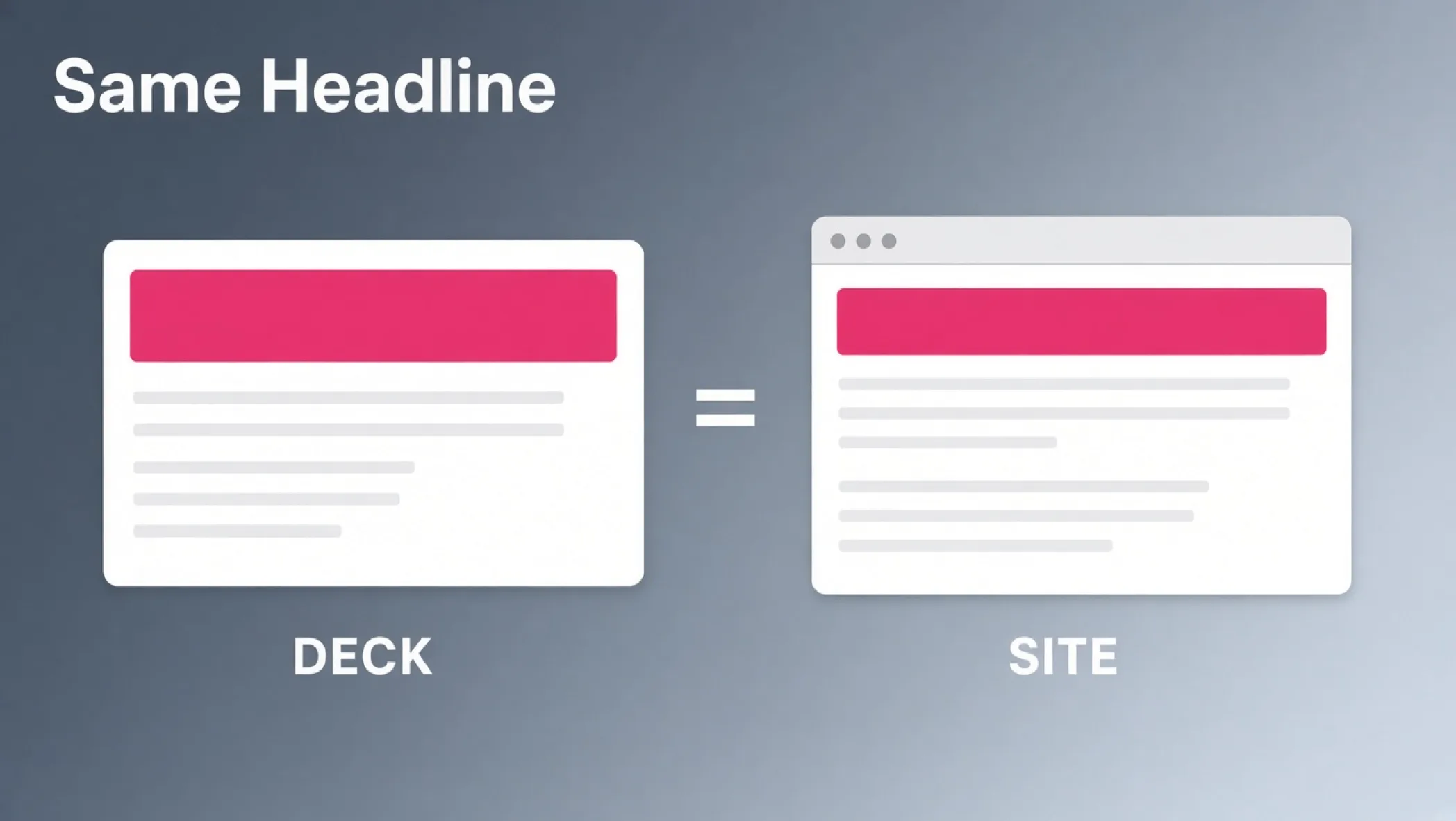
A buyer finds your site. It says you build fast, flexible, tailored solutions. Two weeks later you present a deck that says fixed scope, six weeks, three packages. Nobody lied. But the buyer now has two companies in their head, and they have to ask which one is real.
This happens whenever the site and the deck are written at different times by different people. The fix is not a rewrite. It is an audit with five labels and one shared sheet. It sits next to the landing page brief, which fixes the promise for one page. This one checks the promise across everything a buyer sees.
Start with a one-page message sheet
Framework. Before comparing anything, write down what the company says. Eight lines, one page. If your positioning work is done, most of it already exists. Both the deck and the site get checked against this sheet, not against each other.
| Line | What it holds | Example (hypothetical) |
|---|---|---|
| Who | The buyer, in their role and situation | Operations lead at a 20 to 50 person service firm |
| Problem | The moment that makes them look | Their site no longer matches what sales promises |
| Promise | What they get, in one sentence | A marketing site rebuilt from a written brief, on a fixed scope |
| Proof | What backs the promise, and is cleared to show | Process steps, a sample page map, one live site with approval |
| Next step | The single action | Request a scope call |
| Price posture | How price is framed (not the number if it varies) | Fixed price per package, quoted after the scope call |
| Timeline posture | What you say about duration | Stated per package, depends on content readiness |
| Not for | Who and what you decline | Ongoing paid-ad management, one-page templates |
The last three lines are the ones decks and sites disagree on most. Price, timeline, and who you do not serve are exactly what a salesperson adjusts under pressure and a web page ignores.
Five labels for every slide
Open the deck and the site side by side. For each slide, find the website section that carries the same idea. Then label the pair.
flowchart LR
        D["Deck slide"] --> S["Message sheet"]
        W["Site section"] --> S
        S --> M["Match"]
        S --> R["Drift"]
        S --> G["Gap"]
        S --> O["Orphan"]
S --> X["Conflict"]| Label | What you see | Risk | What to do |
|---|---|---|---|
| Match | Same idea, compatible words | None | Leave it alone |
| Drift | Same idea, different words or different emphasis | The buyer does not realize it is the same thing | Pick one phrase from the message sheet, change the other |
| Gap | The deck says it, the site does not | The buyer had no reason to book the call, or arrives with the wrong expectation | Add to the site if it matters pre-call; leave in the deck if it is a conversation point |
| Orphan | The site says it, nobody says it in the deck | Sales cannot back it up on a call | Add proof to the deck, or remove from the site |
| Conflict | The two say different things | Trust drops at the exact moment of decision | Resolve against the message sheet today, before the next call |
A hypothetical audit
Hypothetical. A small studio compares six slides with the matching site sections. The wording is invented to show how the labels work.
| Deck slide | Site section | Label | Action |
|---|---|---|---|
| "Fixed scope, three packages" | Services page: "Custom solutions for every business" | Conflict | Rewrite site to show the three packages; the sheet says fixed price per package |
| "We start with a written brief" | Process section: "Discovery" | Drift | Rename "Discovery" to "Written brief" on the site, or the reverse, per the sheet |
| "Six-week typical timeline" | Nothing | Gap | Sheet says timeline is stated per package. Add per-package ranges to the site |
| "Not for ad management" | Nothing | Gap | Add a short "not for" line on the services page |
| Nothing | Homepage: "Trusted by leading brands" | Orphan | No proof in the deck or inventory. Remove the line |
| "Request a scope call" | Contact page: "Request a scope call" | Match | None |
Six rows and five changes ordered by risk. Nothing in this example required new design. The work was words.
The three places parity breaks first
- Price and package names: a deck gets a new package name for one deal and it spreads. The site still lists the old one. Buyers compare. Put the names on the message sheet and treat any new name as a change request.
- Proof: a sales rep mentions a result in a call and the slide picks it up. The site never gets it, or gets a bigger version of it. Proof should come from one place: see a claim-and-proof content model.
- Who it is for: the deck narrows after a few calls. The site stays broad because nobody wants to remove a possible customer. A site that speaks to everyone reads, to the one buyer who matters, as speaking to nobody.
What parity does not mean
- Identical copy: a deck is spoken and paced by a person. A page is read at the reader’s speed. The ideas match; the sentences do not need to.
- The same level of detail: the deck can hold specifics for a live conversation. It cannot hold claims the site would contradict.
- Flattening the tone: a founder’s voice on a call and a site’s voice on a page can differ. They should not disagree on what is being sold.
Keep it from drifting again
- One owner for the message sheet. Not a committee. Their name is at the top of the page.
- A change rule: if the offer, price posture, timeline posture, or proof changes, the sheet is updated first, then the deck and the site, within one week.
- A shared proof source. Claims, quotes, and figures are stored once and reused. Nobody retypes a number.
- Ask each new inquiry what they read first. One field on the intake form. When a buyer quotes your site back to you and the deck says something else, you hear it directly.
- A quarterly audit. Put it in the calendar when the sheet is created.
The fourth item pairs with the intake fields in the website measurement plan. Analytics can count form submits. It cannot tell you which sentence the buyer remembered.
What this does not prove
Parity makes the story consistent. It does not make the story right. If the message sheet describes an offer nobody wants, a perfectly matched deck and site will fail in harmony. Parity also does not replace a conversation with a real buyer. It just removes the avoidable surprises before that conversation starts.
Use the message parity checklist for your next quarterly review. If the audit shows the problem is the positioning itself, that is branding work. If it is the pages, that is websites. And if you would like a second reader on the message sheet, send it over.
Frequently asked questions
What is message parity?
The website and the sales deck make the same promises, to the same person, with the same proof, in words a buyer would recognize as one company. It does not mean identical copy. It means a buyer can move from one to the other without hearing a contradiction.
Which one is the source of truth, the deck or the site?
Neither. Keep a one-page message sheet and make both of them follow it. Decks change fast because a person edits them before a call. Sites change slowly. If either one is the source, the other drifts the first week.
Should the deck say more than the website?
Yes, usually. A deck has a person in the room to explain. It can carry more detail, pricing posture, and specifics of a proposal. What it should not do is claim something the site, if read by the same buyer, would contradict.
How often should we run the audit?
Framework: before a launch, after any change to the offer or pricing posture, and once a quarter if neither of those happen. Plan an hour once the message sheet exists, as a starting guess rather than a measured figure.
We have no deck. Does this still apply?
Yes, with whatever you send people. A proposal template, a capabilities PDF, an email signature, and the first reply to an inquiry all carry the message. Treat each one as a slide.