Deterministic Workflows vs. LLM Agents: When to Use Which in Business Automation
A practical architecture guide to deterministic workflows vs large language model (LLM) agents: when to use rule-based pipelines, when probabilistic agents win, and how hybrid systems ship safely in production.
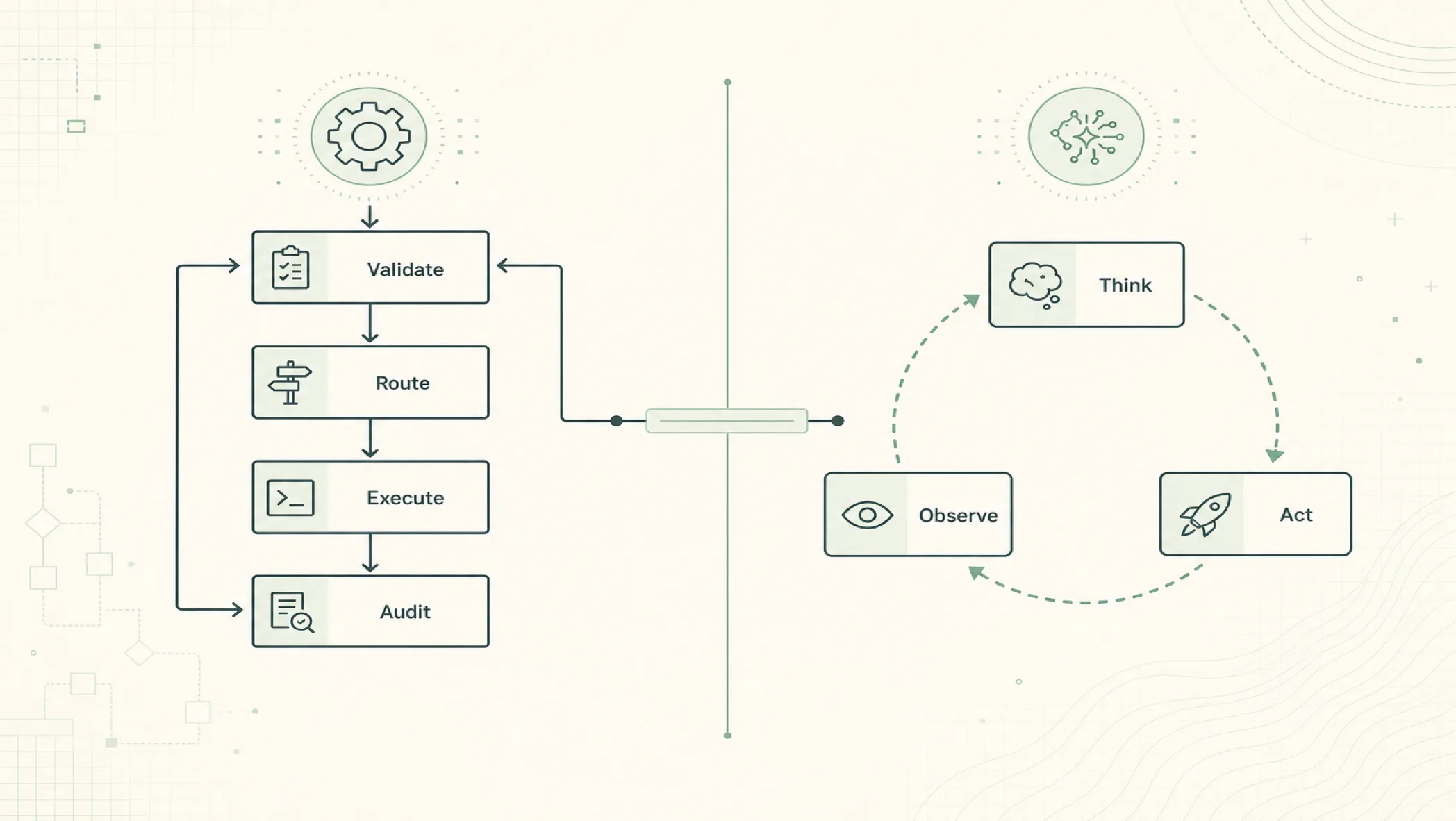
Deterministic workflows follow explicit, hardcoded rules to process data with full predictability. Large language model (LLM) agents use probabilistic reasoning engines to interpret context, select tools, and handle unstructured inputs dynamically. Deterministic systems prioritize zero-latency variance and total auditability; agentic systems trade strict predictability for adaptability across messy data. If you are still mapping the broader landscape, start with the complete guide to AI business automation, then use this article to choose the right execution model for each step of a pipeline.
Quick Reference: Structural and Operational Comparison
| Axis | Deterministic Workflows | Autonomous LLM Agents |
|---|---|---|
| Execution model | Static Boolean logic, state machines, API routes | Probabilistic loops (ReAct, tool-calling, reflection) |
| Predictability | High (reproducible output for every input) | Variable (model drift and stochastic sampling) |
| Cost profile | Fixed compute costs (negligible per execution) | Dynamic token consumption (scales with chain depth) |
| Error handling | Explicit exception catching and static fallbacks | Retry loops, human-in-the-loop (HITL), self-correction |
| Ideal payload | Structured JSON, SQL databases, scheduled syncs | Multi-intent text, ambiguous PDFs, open-ended tasks |
This matrix is the short version. The rest of the article expands each row into architecture you can ship: rule-based pipelines for structured work, agent loops for fuzzy intent, and a hybrid pattern that puts both in their lane.
Deterministic Workflows: The Rule-Based Backbone
Deterministic workflows rely on fixed condition sets. Given input X, the system consistently outputs Y through step sequence Z. Built in tools like n8n, Make, or custom serverless functions, these pipelines handle traditional business logic where execution paths must never diverge.
flowchart LR
    Trigger["Event trigger<br/>webhook / schedule / queue"] --> Validate["Validate schema<br/>auth · types · required fields"]
    Validate --> Route{"Condition tree<br/>Boolean rules"}
    Route -->|Plan = enterprise| PathA["Provision enterprise<br/>API route"]
    Route -->|Plan = starter| PathB["Provision starter<br/>API route"]
    Route -->|Unknown| Fail["Static fallback<br/>alert + dead-letter"]
    PathA --> Log["Audit log<br/>immutable trace"]
    PathB --> Log
Fail --> Log- Why they win: Near-zero per-run infrastructure cost, predictable execution speeds, and absolute legal and operational auditability. If an audit requires proving exactly why a record was updated, a deterministic log trace is clear evidence.
- Where they fail: Brittle handling of unstructured data. A schema change in an incoming API payload or a missing key in a JSON object breaks the pipeline unless an explicit exception branch was pre-configured.
Structural Example: Deterministic Payload Handling
When the payload is structured, path selection is a table lookup, not a conversation. The system maps plan and score fields to a known action path with no interpretation step.
{
  "event": "user.signup",
  "timestamp": 1772630400,
  "data": {
    "user_id": "usr_9921",
    "plan": "enterprise",
    "credit_score": 750
  },
  "action_path": "/api/v1/provision-enterprise-tenant"
}
Same event shape tomorrow yields the same branch. That is the point: no sampling temperature, no tool discovery, no “maybe refund, maybe escalate” judgment call unless you wrote it as an explicit rule.
LLM Agents: The Probabilistic Reasoning Layer
LLM agents operate via iterative reasoning loops such as the ReAct framework. Instead of following pre-mapped code paths, an agent receives an objective, evaluates available tools (via JSON schemas), plans execution steps, and processes returned observations until the objective state is satisfied.
flowchart TD
    Objective["Objective + context<br/>ticket · PDF · thread"] --> Think["Reason<br/>plan next step"]
    Think --> Act["Select tool<br/>JSON schema call"]
    Act --> Observe["Observation<br/>API / DB / search result"]
    Observe --> Enough{"Objective<br/>satisfied?"}
    Enough -->|No| Think
    Enough -->|Yes| Structured["Emit structured result<br/>schema-validated JSON"]
Structured --> Downstream["Deterministic handoff<br/>or review queue"]- Why they win: Extracting structure from chaos. An agent can process a handwritten PDF invoice, an ambiguous customer support email, or an unstructured Slack thread, converting vague human intent into downstream actions.
- Where they fail: Latency, cascading token costs, non-deterministic output drift, and potential hallucinated tool calls (for example, passing invalid arguments to a third-party API).
Agents are not a replacement for workflow engines. They are a specialized interpreter for fuzzy input. Once intent is structured, you usually want boring code again.
The Hybrid Blueprint: Deterministic Wrapper + Agent Core
Production-grade engineering rarely uses pure agents for end-to-end processing. The industry standard pattern wraps probabilistic AI agents inside rigid deterministic structures: authenticate at the edge, let the model parse mess into JSON, then execute side effects only through static code paths you already trust.
flowchart TD
    In["Incoming webhook<br/>unstructured body"] --> Edge["Deterministic validation<br/>API keys · source auth · rate limits"]
    Edge --> Agent["LLM agent core<br/>parse body → structured JSON schema"]
    Agent --> Gate{"Schema + confidence<br/>policy check"}
    Gate -->|Pass| Exec["Deterministic execution<br/>DB write · payment · provision"]
    Gate -->|Fail| Hitl["Human review queue<br/>Slack / dashboard"]
    Exec --> Audit["Audit trail<br/>inputs · decision · outputs"]
    Hitl --> Audit
Read the stack top to bottom: the agent never authenticates callers, never holds raw billing keys as free text, and never writes to production stores with unvalidated prose. It only proposes a structured decision object. Deterministic layers own identity, money movement, and durable state.
Implementation Scenario: Automated Customer Refund Routing
A concrete refund pipeline shows how the three layers cooperate without giving the model a credit card.
- Deterministic edge: A webhook receives an incoming support ticket, validates the signature, and pulls the user’s subscription profile from a PostgreSQL database.
- Agent core: The ticket content and user context pass to a lightweight model (for example Claude 3.5 Sonnet or GPT-4o) with strict function calling. The agent classifies sentiment, extracts intent, and formulates a proposed resolution object such as {"intent": "refund_request", "eligible": true, "confidence": 0.94}.
- Deterministic execution: The system checks if confidence is at least 0.90 and amount is at most $100. If true, an n8n webhook triggers the Stripe refund endpoint automatically. If false, the pipeline routes the payload to a human review queue.
sequenceDiagram
    participant Webhook as Support webhook
    participant Edge as Deterministic edge
    participant DB as PostgreSQL
    participant Agent as LLM agent
    participant Policy as Policy gate
    participant Stripe as Stripe / n8n
    participant Human as Review queue

    Webhook->>Edge: Ticket + signature
    Edge->>Edge: Validate signature
    Edge->>DB: Load subscription profile
    DB-->>Edge: Plan, spend, tenure
    Edge->>Agent: Ticket text + user context
    Agent-->>Edge: Resolution JSON + confidence
    Edge->>Policy: confidence, amount, eligibility
    alt confidence >= 0.90 and amount <= 100
      Policy->>Stripe: Trigger refund workflow
      Stripe-->>Policy: Refund result
    else low confidence or high amount
      Policy->>Human: Triage payload
    end
    Policy->>DB: Write audit record
The agent never calls Stripe directly. It only returns eligibility and confidence. Thresholds, amounts, and API credentials stay outside the probabilistic loop. That separation is what keeps incident response simple when a prompt drifts or a tool schema changes.
Decision Matrix: Choosing Your Architecture
flowchart TD
    Start["New automation request"] --> Shape{"Is input mostly<br/>structured?"}
    Shape -->|Yes| Volume{"Very high volume<br/>or strict audit?"}
    Volume -->|Yes| Det["Prefer deterministic<br/>workflows"]
    Volume -->|No| StillDet["Prefer deterministic<br/>add rules as needed"]
    Shape -->|No / mixed| Paths{"Do intermediate steps<br/>need tool choice?"}
    Paths -->|Yes| Agent["Add LLM agent core<br/>for interpretation"]
    Paths -->|No| Rules["Expand rule tree first<br/>agent only if unmaintainable"]
    Agent --> Wrap["Always wrap with<br/>auth · schema · HITL · limits"]
    Det --> Ship["Ship with observability"]
    StillDet --> Ship
    Rules --> Ship
    Wrap --> Ship
Select deterministic workflows when
- Input data arrives in predictable, structured formats (REST APIs, webhooks, SQL records).
- Compliance requires a fully deterministic execution trail.
- Transaction volume exceeds roughly 10,000 executions daily, where token usage fees become cost-prohibitive.
Select LLM agents when
- Inputs are inherently unstructured (plain text emails, scanned documents, voice transcripts).
- The routing path requires variable tool execution based on intermediate step analysis.
- Hardcoded conditional branches become unmaintainable because of edge-case volume.
Most mature stacks are hybrid by design. Platform choice still matters for the deterministic shell. If you are comparing orchestrators, our breakdown of n8n vs Zapier vs Make covers how each engine handles branching, volume, and self-hosting before you drop an agent node into the middle.
Security, Guardrails, and Failure Recovery
Deploying agentic components requires defensive engineering so failures are loud, costs are capped, and side effects never run on free-form model text.
- Human-in-the-loop (HITL) triggers: Set explicit confidence score boundaries. Any agent output below an established threshold (for example under 0.85) must halt execution and post a triage payload to Slack or a dashboard review queue.
- Schema enforcement: Always enforce structured JSON outputs (OpenAI Structured Outputs, Pydantic validation, or equivalent) on agent tool calls. Never pass raw LLM text strings directly into production database writes.
- Cost and loop limits: Wrap agent reasoning chains in strict execution limits (for example a maximum of five tool calls per run) to prevent infinite loops when an external API is down.
flowchart LR
    AgentOut["Agent candidate output"] --> Schema{"Valid JSON schema?"}
    Schema -->|No| Reject["Reject · log · retry once"]
    Schema -->|Yes| Conf{"Confidence<br/>above threshold?"}
    Conf -->|No| HITL["Route to human"]
    Conf -->|Yes| Limits{"Within tool-call<br/>and cost budget?"}
    Limits -->|No| Cap["Stop chain · alert ops"]
    Limits -->|Yes| Side["Allow side effects<br/>static code only"]
Treat these controls as part of the product, not a later security pass. The hybrid pattern only works if the gates fire every run, not only on demos.
Putting It to Work
Default to deterministic for structured, high-volume, audit-sensitive steps. Introduce an LLM agent only where interpretation genuinely reduces edge-case sprawl. Ship the hybrid shape: validated edge, constrained agent, deterministic execution. Measure latency, token cost, and HITL rates early so you know whether the probabilistic layer is earning its variability.
When you are ready to map a first production path, the step-by-step playbook in How to Automate Your Business with AI is a practical next read after this architecture decision.